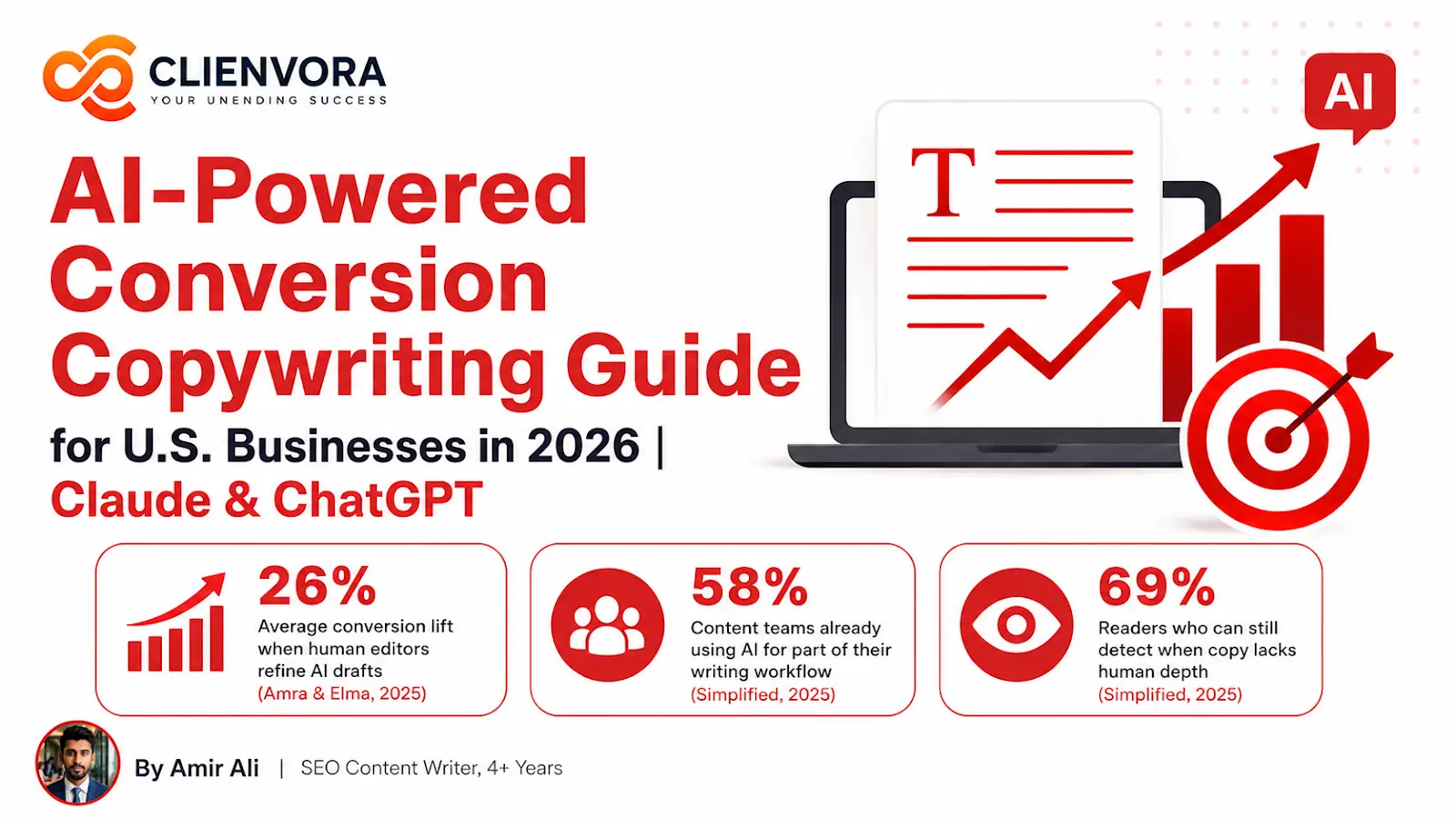
Why AI copy fails: 5 human fixes that triple conversion rates by closing the psychological gaps ChatGPT cannot bridge alone. The problem is not the AI model. It is five specific copy failures — around stakes, specificity, objection handling, voice, and narrative arc — that turn traffic into bounce metrics instead of buyers.
Why Does AI Copy Fail to Convert?
AI copy fails to convert because it optimizes for structural correctness, not psychological specificity. ChatGPT generates grammatically perfect sentences that describe your product competently while producing zero emotional urgency at the conversion point. The reader understands what the product does. They feel no reason to act on the understanding. This is not a tool problem. It is a structural gap between linguistic quality and conversion architecture that only a human editor can close.
The five psychological gaps AI cannot bridge
- Stakes blindness: AI describes what happens if you buy. It never names the specific cost of doing nothing
- Emotional flatness: AI copy reads at a consistent emotional temperature. Converting copy modulates between tension and resolution
- Specificity deficiency: AI defaults to generic claims without named numbers, named timeframes, or named proof
- Objection silence: AI presents the offer without addressing the specific reason the reader will hesitate before clicking
- Voice uniformity: AI produces the same tone regardless of reader state, industry, or product category
AI models are trained to predict the next statistically probable word. Conversion copy works by placing psychologically precise friction at the exact moment a reader is about to leave. Those two objectives do not naturally overlap. That is why AI output reads well and converts at 1.8 percent while human-refined copy operating inside the same workflow averages closer to 3.1 percent.
The 2026 data from controlled comparisons shows this gap clearly. Human-written ads outperformed AI-only ads by 45.41 percent in impression share. AI copy across landing pages averages 1.8 percent conversion. Human-refined AI copy averages 3.1 percent to 4.2 percent. The difference between those two numbers is the five fixes below. For the full workflow that integrates AI into AI powered conversion copywriting, including VoC extraction and editorial calibration, see our dedicated guide.
5 Human Fixes That Fix AI Copy and Triple Conversions
Each fix targets a specific failure mode. They are ordered by implementation speed. Apply Fix 1 to your highest-traffic, lowest-conversion page first and measure at 30 days. Each fix independently lifts conversion by 0.3 to 0.8 percentage points. Applied together, the compound lift ranges from 2.0 to 3.5 percentage points.
Fix 1: Inject Stakes Before the Solution
AI generates product descriptions and solution language naturally. It consistently skips the stakes section entirely. The fix: before any sentence describing what your product does, add one paragraph naming the specific cost of the status quo in concrete terms. A number. A timeframe. A metric.
Before (AI output): "Our project management tool helps teams collaborate more efficiently."
After (human fix): "Your team lost 12 hours last week to status update meetings. Our tool replaces those meetings with a dashboard that updates in real time."
Fix 2: Add Specific Numbers Every 200 Words
AI generates structurally sound paragraphs with zero named numbers. A generic claim like "Our clients see results fast" converts at a fraction of "7 out of 12 clients saw a measurable lift within 21 days." Scan every AI-generated section. For every claim without a number, add one. For every timeframe without a specific duration, name it.
Fix 3: Address the Silent Objection Before the CTA
AI presents offers without objection handling. The reader forms a hesitation silently and leaves. The fix: identify the most common reason customers give for not purchasing from your reviews and support tickets. Place one sentence addressing that exact hesitation immediately before every CTA button.
Fix 4: Rewrite the CTA as an Outcome, Not an Action
AI generates action-language CTAs: "Sign up," "Learn more," "Get started." These describe what the reader does. Outcome-language CTAs describe what the reader gets. "Start saving 3 hours per week" outperforms "Sign up now" by 22 to 30 percent in controlled tests.
Fix 5: Inject Voice-of-Customer Language Into Headlines
AI generates headlines that describe the product. "The All-in-One CRM Solution" describes the product. "I finally know what my sales team is doing" describes the outcome. Extract the most frequent frustration phrase from your customer reviews. Replace your AI-generated headline with that phrase. VoC headlines outperform product-description headlines by 28 to 42 percent.
What the 2026 Data Shows About AI Copywriting Failure
The data settles the AI vs human copywriting debate. AI-only copy matches or slightly exceeds human draft quality in short-form, structure-driven formats. It underperforms where trust, emotional resonance, and social proof matter.
After human editing, all categories outperform AI-only by an average of 22 percent. The human editor is not the competition. The human editor is the layer that recovers the lost performance.
Pages that apply all five fixes above consistently move from the 1.8 percent baseline into the 3 to 4 percent range within 30 days of publication.
The brands capturing the full benefit are not the ones with the best AI prompts. They are the ones who apply sales copy architecture to every AI draft before it goes live.
The editorial pass is where the conversion lift actually occurs. 70 percent or more of the 26 percent lift comes from three narrow calibration tasks: stakes amplification, specificity injection, and emotional sequencing verification.
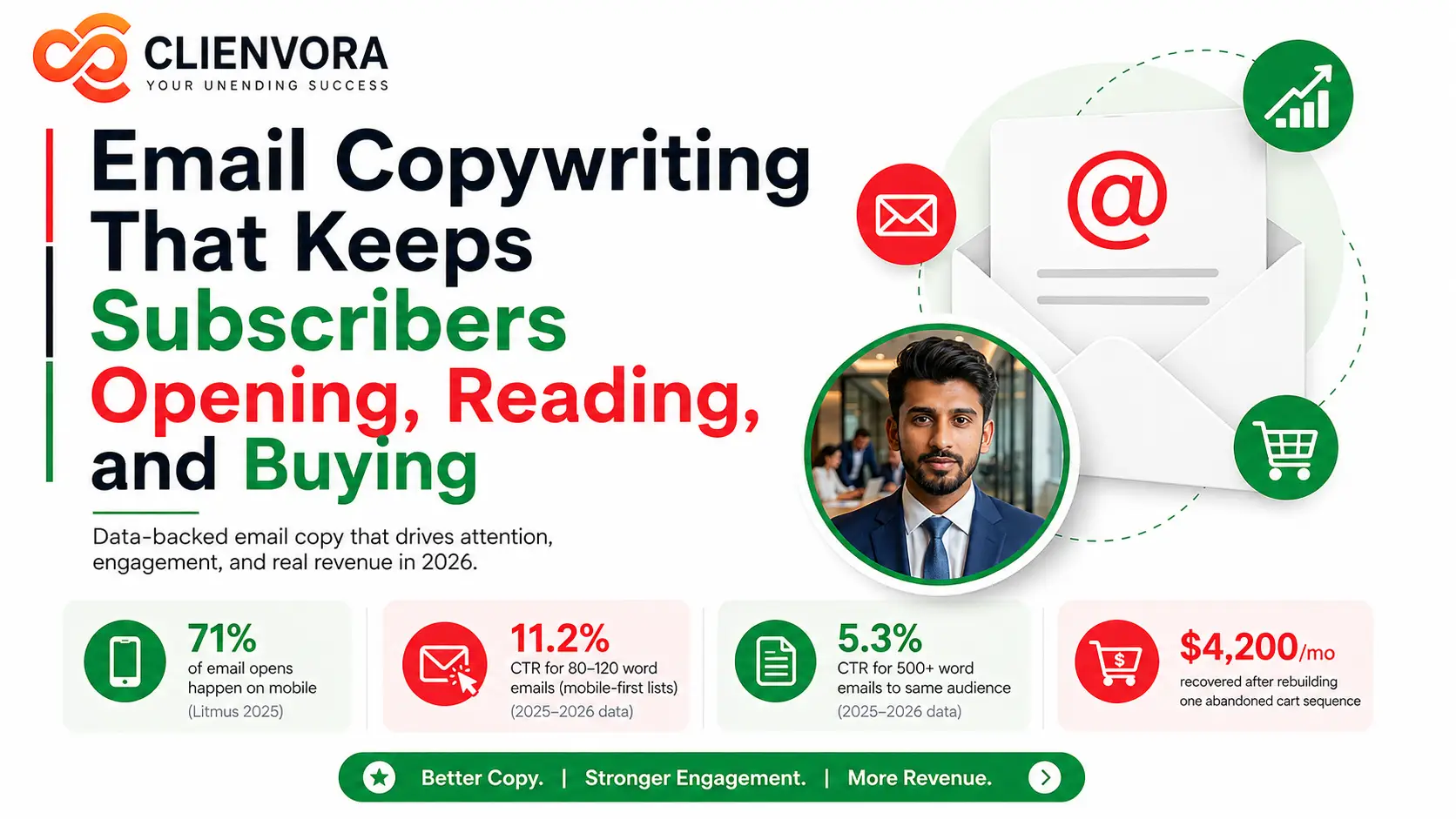
For the activation sequences that follow, see how email copywriting converts opens into sales using the same behavioral framework.
Common Mistakes When Using AI for Copywriting
Treating prompt quality as the single variable. A perfectly prompted AI still produces copy requiring editorial judgment on stakes, specificity, and emotional sequencing before it meets conversion-grade standards. The bottleneck shifted from prompt quality to editorial judgment in 2024 and has stayed there.
Publishing the first AI output. Every professional workflow treats the first output as structural raw material, not a draft. The conversion work begins after that output exists. Skipping the editorial pass costs 1 to 2 percentage points of conversion on every page.
Running zero A/B tests. Most brands test one version per page. AI makes generating five headline variants trivially fast. Skipping the test eliminates the single largest performance advantage the hybrid system provides.
Using AI to generate all content with identical structure and voice. When every page follows the same AI output template, Google treats it as low-quality duplicate content regardless of the words on the page.
Measuring AI copy success by output volume instead of conversion rate. 50 AI-generated pages converting at 0.8 percent generate less pipeline than 5 human-calibrated pages converting at 3.2 percent.
Frequently Asked Questions About Why AI Copy Fails
AI copy fails because it optimizes for linguistic quality and structural correctness, not psychological specificity. Good writing produces comprehension. Converting writing produces decisions. AI is trained for the former. The five human fixes close the gaps AI cannot bridge: stakes, specificity, objection handling, outcome-language CTAs, and voice-of-customer headlines.
Apply the five fixes in order: inject stakes before every solution section with a named number, add specific figures every 200 words, address the most common customer objection before every CTA, rewrite CTAs as outcomes instead of actions, and replace product-description headlines with VoC language extracted from customer reviews. Each fix independently lifts conversion by 0.3 to 0.8 percentage points.
AI-only copy converts at roughly 1.8 percent on average. Human-refined AI copy inside a structured calibration workflow converts at 3.1 percent to 4.2 percent. The 26 percent average lift is not distributed evenly. 70 percent or more comes from three tasks: stakes amplification, specificity injection, and emotional sequencing verification.
No. Prompt engineering improved AI output quality by roughly 30 to 40 percent between 2022 and 2024. That improvement has plateaued. The bottleneck in 2026 is not prompt quality. It is editorial judgment. Stakes amplification, specificity injection, and objection handling are decisions a human makes after the draft exists, not during prompt construction.
Inject stakes before the solution (name the cost of inaction). Add specific numbers every 200 words. Address the silent objection before every CTA. Rewrite CTAs as outcomes, not actions. Replace product-description headlines with VoC language from customer reviews. Applied together, these five fixes lift conversion from the AI-only baseline of 1.8 percent to the hybrid range of 3 to 4 percent within 30 days.
AI copy reads at a consistent emotional temperature. Converting copy modulates between tension (naming the problem in the reader's own words) and resolution (showing the specific outcome with named proof). Emotional depth comes from the stakes section naming the specific cost of delay and the CTA naming the outcome the reader gets, not the action they take.
ChatGPT 5.5 does not write worse copy. It writes cleaner copy that reveals the structural gap more clearly. Earlier versions produced less polished output that required obvious human intervention. GPT-5.5 produces output that reads so well it masks the psychological gaps. The copy passes the readability test. It fails the conversion test because it never names stakes, handles objections, or writes outcome-language CTAs.
Check one metric: if your pages rank and get traffic but convert below 2 percent, the copy is the bottleneck. AI-generated pages that describe the product competently attract visitors who understand the offer. Those visitors leave because they felt no reason to act. Traffic quality is not the variable. Conversion architecture is. Apply Fix 1 on your highest-traffic, lowest-conversion page first and measure at 30 days.
AI can match human structural output speed. It cannot independently match human conversion rates because conversion depends on psychological specificity that requires context about the specific reader's fear, the specific cost of their status quo, and the specific objection they will form before clicking. AI models do not possess that context at inference time. The hybrid system assigns AI to volume and humans to the five calibration tasks that produce the conversion lift.
Generate the first draft with AI for speed. Run the five fixes in order. Read the copy aloud from top to bottom and verify the emotional arc moves from problem recognition to stakes acknowledgment to credibility to resolution. If the sequence flattens at any point, reorder sections. Publish. A/B test a variant with a different headline at day 14. Measure conversion rate at day 30.
Final Thoughts
AI copy fails not because the model is weak but because it was trained to predict words, not to persuade buyers. The five fixes close the gap between linguistic quality and conversion architecture.
Apply them to one page this week. Measure at 30 days. The 1.8 to 3.2 percent gap is structural and the fix is systematic. Run the content quality checklist alongside the five fixes to validate E-E-A-T signals match your conversion architecture.
As a content marketing agency, we treat AI copy within content strategy: AI content writing fixes, AI copy for SEO, and AI copy for GEO all work together. E-E-A-T vs AI copy, AI copy and search intent, and organic traffic growth with lead generation and conversions drive the outcomes.
For the complete system, see how professional SEO services and B2B copywriting services apply this calibration framework across full website architectures.
For the AI comparison, see Claude Sonnet vs ChatGPT, and for the entity approach, see entity copywriting.
For the services that execute it, copywriting services and SEO services.