A production-stage comparison, not a feature list. Which AI produces copy that requires the least editorial rework per page.
Is Claude Sonnet Better Than ChatGPT for SaaS Landing Page Copy?
Which AI writes better SaaS pages is the wrong first question. The right question is which AI produces copy that converts when human-edited, because that is the workflow every high-performing SaaS team uses in 2026.
Is Claude Sonnet better than ChatGPT for SaaS? The answer depends on whether you are in the ideation phase or the drafting phase. Viewed as AI content writing comparison, this is also a content strategy decision: a content marketing agency places the right tool at the right stage of the pipeline, then routes the output through human editorial judgment. For the full content strategy behind AI tool selection, see our content strategy services.
The real failure point is constraint adherence, not prose quality. When a SaaS marketer writes a brief, they specify: target audience (CTOs, not developers), vocabulary restrictions (no "scalable," no "next-generation"), tone parameters (consultative, not conversational), word count ceiling (120 words for hero copy), and specific proof requirements. Validate every AI draft against the conversion elements checklist to make sure CTAs, trust signals, and outcome language survive the prompt-to-publish handoff.
A brief with those five constraints is not unusual. It is a Tuesday-morning brief, and it is the minimum input for any ChatGPT prompts for SaaS copy 2026 workflow that expects to produce conversion-focused output.
Ask both models to write a 600-word introduction for a B2B SaaS blog targeting CTOs, using a consultative but direct tone, avoiding buzzwords, and not starting with a question. Claude typically satisfies all constraints on first pass. ChatGPT slips on one or two, per Free Academy's 2026 writing comparison.
ChatGPT was trained to be helpful and produce content quickly, which means defaulting to the most statistically likely "good" answer for a given prompt type. That default for "write SaaS landing page hero copy" trends toward generic corporate language.
Claude's constitutional AI training produces different output for Claude Sonnet for technical copywriting: it holds nuanced ideas in tension, processes longer instruction sets without dropping constraints, and produces writing that requires less post-draft editing per Neel Networks' 2026 web design AI evaluation.
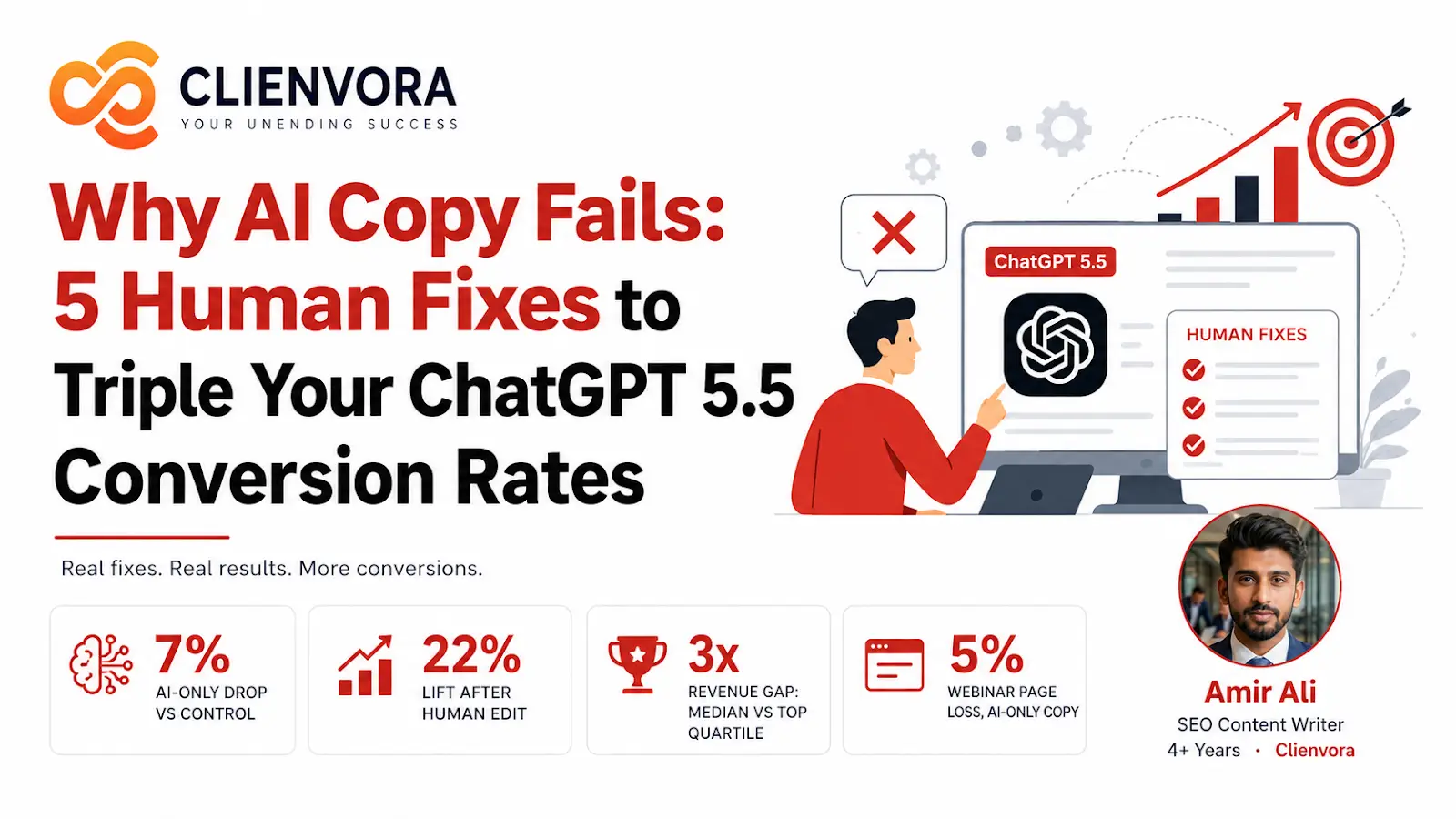
For the human side of the equation, see why AI copy fails without editorial calibration, and how E-E-A-T signals are preserved when AI tools run inside a documented content strategy rather than beside it.
Which AI Actually Produces the Reading Level That Converts SaaS Pages?
Claude Sonnet, without specific prompting about reading level, naturally writes SaaS copy that scores closer to grade 8 on the Flesch-Kincaid scale.
ChatGPT, in its default behavior, skews toward grade 10 to 12 on similar prompts because its training reward signals favor comprehensive-sounding responses.
Both models can be explicitly prompted to write at grade 6, and both comply. But compliance quality differs: Claude produces grade-6 copy that still sounds authoritative, while ChatGPT's grade-6 output sometimes collapses into oversimplification that reads condescending to technical SaaS buyers.
The practical implication for SaaS teams: if your workflow involves a human editorial pass (and it should), Claude saves approximately 3 to 5 minutes of editing time per 500 words by producing first drafts that require tone adjustment rather than tone reconstruction. Across a standard 10-page SaaS website build, that is 30 to 50 minutes of recovered editing time that can be spent on conversion architecture instead of tone repair.
Claude Sonnet vs ChatGPT for SaaS Homepage Copy: What Each Model Does Differently
Where ChatGPT genuinely outperforms is headline volume. When a page needs 12 headline variants for A/B testing, ChatGPT produces them faster and with greater structural variety. Its tendency to riff on multiple angles simultaneously makes it the right tool for the ideation phase, before writing the page that ships.
| Task | Claude Sonnet | ChatGPT | Winner |
|---|---|---|---|
| Hero copy (120 words, 5 constraints) | Satisfies all 5 constraints on first pass | Satisfies 3 to 4; needs constraint reminder | Claude |
| Reading grade level (default) | Grade 8 | Grade 10 to 12 | Claude |
| Headline variants per prompt | ~7 variants | ~15 variants | ChatGPT |
| Tone accuracy without tone samples | Consultative by default; directionally correct | Corporate default; often needs re-tuning | Claude |
| Constraint adherence (5-constraint brief) | High; rarely drops a constraint | Medium; drops 1 to 2 constraints per pass | Claude |
| Editing time saved per 500 words | 3 to 5 minutes | Baseline (needs more rework) | Claude |
Expert objection: "Prompting fixes everything. Any model can produce great SaaS copy with the right prompt."
This is the most-repeated claim in AI copywriting discussions, and it is incomplete in a way that matters when you have fifteen pages to write and a two-week deadline. Yes, extensive prompting closes the gap between Claude and ChatGPT for SaaS copy. The question is the cost of that prompting overhead, counted in minutes per page, not tokens.
In practice, a Claude brief for SaaS hero copy requires three constraint specifications: audience, tone, and vocabulary restrictions.
A ChatGPT brief for equivalent output quality requires six to eight: the same three, plus explicit instruction to avoid generic openers, a reading-level specification, a reminder not to lead with product name, and often one or two example sentences. That difference compounds across a ten-page website build.
The "just prompt better" advice is technically true and practically expensive for teams producing SaaS copy at volume.
Best Prompts for SaaS Feature Descriptions
"You are a SaaS copywriter. Below is a feature list for [product]. Translate each feature into a benefit statement that describes what the reader gets, not what the product does. Target audience: [role]. Tone: consultative, not salesy. Reading level: 7th grade. Avoid: scalable, robust, seamless, leverage, next-generation."
"Generate 12 headline variants for a SaaS [product type] landing page. Target: [role]. Each headline must lead with a specific pain point or measurable outcome. Include formats: question, contradiction, challenge, urgency. Max 12 words each. No generic adjectives. No product name in the headline."
"Write a 150-word section addressing the three most common objections a [role] has when evaluating [product category]. Name each objection explicitly. Respond with evidence, not marketing language. Tone: honest and consultative. Reading level: 6th grade."
Best AI Tools for SaaS Marketers 2026
The question is not whether to use AI for SaaS copy. The question is the specific division of labor that maximizes output quality per minute spent.
The following workflow assigns each tool to the phase it performs measurably better, reducing total per-page creation time from approximately 2.5 hours (human-only) to 45 minutes (hybrid) while maintaining conversion-grade quality. The same workflow produces SEO-optimized SaaS copy built for organic traffic, and the GEO structure of each page keeps it visible to AI answer engines.
SaaS Copy Productivity Cost Calculator
Estimate how many hours you save by assigning the right AI to each copywriting phase.
Hours saved per month with hybrid AI workflow (Claude for drafts, ChatGPT for variants, human for editorial)
FAQs: Claude Sonnet vs ChatGPT for SaaS Copy
The SaaS Copy AI Decision: Stop Asking Which Is Better
The question is not which AI writes better SaaS copy in 2026. The question is which AI produces output that requires the least editorial rework for the specific phase of your workflow you are assigning it to.
For ideation and headline generation: ChatGPT. For drafting and constraint-heavy sections: Claude Sonnet. For the final conversion architecture layer: a human editor. Deploy each to the phase they perform best, route the output through editorial calibration.
The metric that improves is not output quality. It is minutes-to-publish per page at conversion-grade quality.
Get a free SaaS copy audit from Clienvora. We'll evaluate your current copy against the Constraint Adherence Framework and deliver a prioritized fix plan. For the service detail, see our copywriting services, SEO services, and why SaaS companies need a dedicated copywriter.