High open rates with low purchases mean 7 specific copy failures in your email sequence. This guide covers the behavioral trigger framework, the psychology of the unread-to-purchase gap, a 7-phase email copywriting process, and exactly where conversions break.
What Is Email Copywriting?
Email copywriting is the process of writing emails that move subscribers from open to purchase. When your emails get opened at 34 percent but nobody buys, the problem is not the subject line.
The problem is the body copy. The subject line earned the click. The body copy failed to carry the reader to the purchase decision.
AI powered conversion copywriting applies the same behavioral architecture to email sequences that it applies to landing pages. As a content marketing agency, Clienvora treats email as part of the content strategy, so email content writing, lead generation, and conversions stay aligned with the same search intent map that drives the rest of your pipeline.
The four reasons your email body copy fails
| Problem | What It Looks Like | What Fixes It |
|---|---|---|
| Subject-to-body mismatch | Subject promises one thing, body delivers something else | Write the body first, then extract the subject line from the body's strongest claim |
| Feature-dense body copy | Body describes product features, not reader outcomes | Translate every feature into the reader's specific after-state |
| Generic CTA language | Buttons say "Learn More" or "Shop Now" | CTA names the outcome: "Start Saving 3 Hours Per Week" |
| No objection handling | Email presents offer with zero risk reversal | Name the specific hesitation and remove it before the CTA |
How Does Email Copywriting Work?
Email copywriting works by matching the psychological state of the reader at the moment they open with a trigger designed to move them to the next decision stage. Most sequences contain only the solution trigger. The recognition, stakes, and urgency triggers that prepare the reader to accept the offer are absent.
The Behavioral Trigger Framework
| Trigger Type | Reader State | Copy Strategy | CTA Type |
|---|---|---|---|
| Recognition Trigger | "This person understands my problem" | Lead with the reader's exact situation in their own vocabulary | Educational (read, watch, download) |
| Stakes Trigger | "This problem is costing me more than I realized" | Quantify the cost of the status quo with a specific number | Comparison (see the difference) |
| Solution Trigger | "This could actually work for me" | Present specific outcome with named proof, not product description | Transactional (buy, start trial) |
| Urgency Trigger | "I should do this now, not later" | Name the specific cost of delay with a timeframe | Closing (limited time, last chance) |
Most email sequences contain only Solution Trigger emails. They present the offer and ask for the sale.
The Recognition, Stakes, and Urgency triggers that prepare the reader to accept the offer are missing. The result is the analytics pattern you are seeing: strong opens, weak conversions. The sequence is structurally incomplete.
Applying this framework is the same principle used in sales copy that turns warm traffic into buyers: the reader arrives with intent, and the copy either confirms the trust or loses the sale.
How to Write Email Copy That Converts
The 7-phase email copywriting process moves from subscriber state mapping through revenue measurement. The sequence matters because each phase feeds the next. Skip phase one and every downstream decision is built on a guess about who your reader actually is.
Subscriber State Mapping
Document where each subscriber segment is in their buyer journey. A subscriber who joined yesterday from a pain-point blog post is in a different psychological state than a subscriber who has opened six emails without buying.
VoC Language Extraction
Pull verbatim customer language from replies, reviews, and support tickets. These phrases become your email body vocabulary. Writing in the reader's own words produces recognition signals that generic marketing language cannot produce.
Trigger Sequence Architecture
Map Recognition, Stakes, Solution, and Urgency triggers across the email sequence in the reader's decision order. Each trigger addresses a specific hesitation that the previous trigger left unresolved.
Objection-Handling Placement
Place specific objection-addressing language in the email immediately before the CTA, not in a separate FAQ email. The reader needs the objection removed at the moment of decision, not three emails earlier.
CTA Outcome Language
Every CTA names the outcome, not the action. "Get the plan" converts higher than "Click here." Outcome-language CTAs outperform action-language CTAs by 22 to 30 percent in email A/B tests.
A/B Test Subject vs Body Separately
Test subject line variants separately from body variants. A strong subject combined with a weak body masks the body problem in aggregate metrics. Isolate each variable to identify the actual bottleneck.
Revenue-Per-Email Measurement
Track revenue generated per email sent, grouped by subscriber segment. A campaign with 25 percent open rate and 3 percent click-to-purchase rate delivered more revenue than a campaign with 45 percent open rate and 0.5 percent click-to-purchase rate. Track revenue per email sent, not open rate.
Email preview text: the space most brands waste
Email preview text is the snippet that appears next to your subject line in the inbox. Treat it as an extension of the subject line that gets more explicit about what the reader gets inside.
The best preview text answers a question raised by the subject line or follows up on a thought. A subject line that reads "Your open rate is 34 percent" paired with preview text that reads "Your revenue per email is zero. Here is the fix" converts higher than subject-plus-preview combinations that repeat the same idea.
Why Emails Get Opened But Nobody Buys
The subject line earned the open. The body copy failed to convert. These three mistakes appear in thousands of email campaigns right now, and each one independently costs 0.3 to 0.8 percentage points of click-to-purchase rate.
The subject line earns the open. The body earns the sale. When you write the subject line first, you write the body to justify the subject line. When you write the body first, you write the subject line from the body's strongest claim. The second order produces subject-to-body alignment. The first order produces the gap your analytics are showing.
A subscriber who joined yesterday from a pain-point blog post is in a different psychological state than a subscriber who has opened six emails without buying. Sending the same email to both produces opens from the segment that trusts you and zero purchases from the segment that needs more evidence.
Open rate measures subject line performance. It tells you nothing about whether the email earned revenue. Track revenue per email sent, not open rate. A campaign with higher opens but lower conversions is structurally broken. A campaign with lower opens but higher conversions has body copy that works.
How to Choose Email Copywriting Services
Choosing the right email copywriting services determines whether your rewrite produces revenue lift or just refreshed words. Ask for a before-and-after click-to-purchase rate from a previous engagement. If they cannot provide one, they measure activity, not outcome.
- VoC extraction capability: ask whether they mine subscriber replies, reviews, and support tickets for the language that feeds email body copy
- Behavioral trigger architecture: ask whether they structure sequences around Recognition, Stakes, Solution, and Urgency triggers, or whether they write standalone email copy
- Segmentation integration: ask how they adapt copy to different subscriber segments based on where each segment sits in the buyer journey
- Revenue measurement: ask whether they track revenue per email sent or just open rate and click rate
- Industry experience: ask for an email from your vertical. B2B copywriting services and B2C ecommerce sequences use fundamentally different trigger architectures, and SaaS onboarding sequences map objections across a multi-touch evaluation rather than a single purchase moment.
Whether you hire a freelance email copywriter or a full-service agency offering email marketing copywriting services, the evaluation framework stays the same. Ask for a trigger map of your proposed sequence before signing. If they cannot show you which email addresses each behavioral trigger, they are selling you word count, not conversion architecture. For context on whether to handle this in-house or outsource, see our guide to website copywriting for small businesses.
Email Marketing ROI Calculator
Enter your current email metrics to see how much revenue you are losing from body copy that gets opened but never converts. The default values represent a typical 10,000-subscriber list with strong opens and weak conversions.
Email Revenue Gap Calculator
Estimate how much revenue you are losing from email body copy that gets opened but not acted on.
Estimated additional monthly revenue from improved email body conversion
Frequently Asked Questions About Email Copywriting
Your subject line earned the open. Your body copy failed to convert. The three most common causes: the opening line did not acknowledge why the reader subscribed, the body described features instead of outcomes, and no email in the sequence addressed the specific objection that made the reader hesitate after the click. Fix the body-first writing order: write the body from the customer's own words, extract the subject line from the body's strongest claim, and make sure every email maps to a behavioral trigger.
Implement the Behavioral Trigger Framework: Recognition Trigger (name the reader's exact situation in their own words), Stakes Trigger (quantify the cost of inaction with a specific number), Solution Trigger (present specific outcome with named proof), and Urgency Trigger (name the cost of delay). Most sequences contain only the Solution Trigger and skip the three that prepare the reader to accept it. The sequence is structurally incomplete. Fill the gaps in trigger sequence order.
Email sequences range from $500 to $2,500 depending on sequence length, research depth, and subscriber segmentation complexity. A behavioral trigger rewrite of a 5-email sequence that lifts click-to-purchase rate from 0.8 percent to 3 percent on a 10,000-subscriber list at $75 AOV generates approximately $5,610 in additional monthly revenue, recovering the copywriting cost within the first month. Enterprise email copywriting services from agencies cost $2,500 to $7,500 and include full VoC extraction and A/B testing infrastructure.
Email copywriting services specialize in the subscriber decision sequence: subject line architecture, body copy triggers mapped to buyer stages, objection handling placement near the CTA, and revenue-per-email measurement. General copywriting covers a broader range of formats without the email-specific constraints of preview text optimization, sequence architecture, and segmentation. Email specialists also understand deliverability factors that affect whether the copy ever reaches the inbox.
The Behavioral Trigger Framework structures email body copy around four reader states mapped to specific triggers: Recognition (the reader feels understood), Stakes (the reader understands the cost of doing nothing), Solution (the reader sees a specific path to the outcome), and Urgency (the reader acts now instead of later). Each trigger maps to a specific copy strategy and CTA type. Sequences that contain all four triggers convert at significantly higher rates than sequences that only contain the Solution trigger.
Write the body first. The body earns the sale. Write the body from your VoC extraction data, using the customer's own language for problem recognition, stakes elevation, and solution presentation. Then extract the subject line from the body's strongest single claim. This order guarantees subject-to-body alignment. Writing the subject line first forces you to write the body to justify a promise that may not map to the reader's actual state. That gap is what your analytics are showing.
Email preview text is the second-most-read piece of copy after the subject line. Treat it as an extension of the subject line that gets more explicit about the value inside. The best preview text answers a question raised by the subject line or follows up on a thought the subject line started. A subject line plus preview text combination that tells a two-part story converts higher than combinations that repeat the same idea across both fields.
A minimum viable sales sequence has 4 to 7 emails, one for each behavioral trigger in sequence order: Recognition, Stakes (1 to 2 emails), Solution (1 to 2 emails), Urgency (1 to 2 emails). Sequences shorter than 4 emails compress triggers and lose conversion at the skipped stages. Sequences longer than 7 emails without adding new trigger content produce diminishing returns and increased unsubscribe rates.
Track revenue per email sent, grouped by subscriber segment, not open rate. Open rate measures subject line performance. Click-to-purchase rate measures body copy performance. Isolate these two metrics from each other when testing. A subject line A/B test measures one variable. A body copy A/B test measures a different variable. Combining them in a single test masks which variable produced the result.
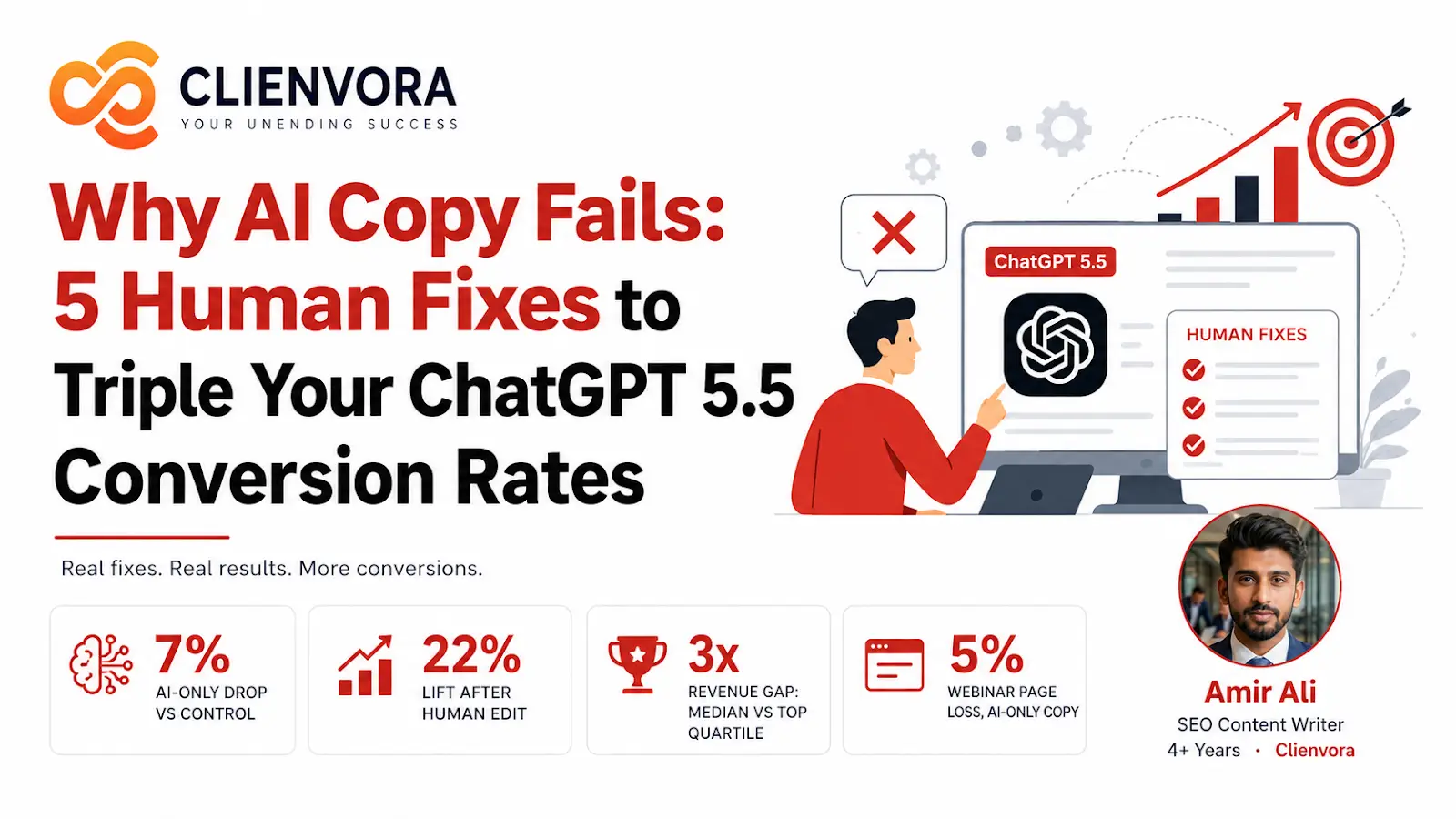
AI can generate structurally sound email drafts at scale. It cannot independently perform VoC extraction from subscriber replies and reviews, map behavioral triggers to subscriber segments, or write outcome-language CTAs that convert at the top of the range. Use AI for the construction phase. Assign the calibration phase to a human. See why AI copy fails for the specific tasks that produce the conversion lift.
Final Thoughts
A high open rate with zero purchases is not a mystery. It is a structural gap between the subject line that earned the click and the body copy that failed to close. Map the triggers. Write body first. Track revenue per email sent. The fix is architecture, not better vocabulary. Validate your landing pages against the conversion elements checklist to close the click-to-purchase gap.
Get a free email copy audit from Clienvora. We will analyze your highest-volume sequence against the Behavioral Trigger Framework and identify exactly where your emails are losing buyers. For the page that receives those clicks, see landing page copy that converts, and for growing the organic traffic that feeds the sequence, our SEO services.