Ecommerce copywriting doubles revenue by restructuring product pages around objection removal, not description volume. This guide covers the step-by-step rewrite process, a skincare brand case study that moved from 1.4 percent to 2.7 percent conversion on the same traffic, and how to hire a product description copywriter who thinks in conversion metrics.
What Are Ecommerce Copywriting Services?
Ecommerce copywriting services deliver product description rewrites, category page copy, and email sequence copy that increase conversion rate on your existing traffic. The metric that matters is revenue improvement per session, not content volume.
A product description copywriter who rewrites three pages that each lift conversion by 0.5 percentage points has delivered more revenue than a generalist who delivers 50 pages at the same conversion baseline. This is the same principle behind AI powered conversion copywriting: the editorial calibration phase produces the lift, not the generation phase.
As a content marketing agency, Clienvora builds ecommerce content strategy around search intent and buyer intent on every product page, and the content writing is delivered through ecommerce SEO copywriting that feeds organic traffic, lead generation, and revenue growth together.
Revenue equals Sessions multiplied by Conversion Rate multiplied by Average Order Value. Copywriting improves the middle variable. A 40 percent improvement in conversion rate on 10,000 monthly sessions at $85 AOV is worth $28,560 in additional monthly revenue per month.
What ecommerce copywriting services deliver
- Product page rewrites: VoC-headlines, objection-addressing descriptions, social proof placement near the Add to Cart button
- Category page copy: benefit-led headers that move browsers into product pages instead of back to search
- Cart abandonment emails: recovery sequences written in the customer's exact purchase hesitations extracted from reviews
- Homepage copy: trust-building architecture that confirms the brand promise for returning warm traffic
- Post-purchase emails: retention and cross-sell copy that increases lifetime value per customer
How Do Ecommerce Copywriting Services Work?
Ecommerce copywriting services work by extracting the exact language your buyers use from verified purchase reviews, then rebuilding product pages around that language. The process replaces manufacturer-formatted descriptions with conversion architecture that addresses objections before they form and moves the reader from browsing to buying.
The 4-step rewrite process
Review Mining and VoC Extraction
Collect 50 or more verified purchase reviews. Extract top phrases describing why buyers chose this product and their hesitations before purchasing. These phrases become headlines and objection-handling blocks.
Competitor Copy Audit
Audit the top 3 competing product pages. Your copy must differentiate on at least one dimension or buyers default to price comparison. Identify the dimension your competitors are not using and claim it.
Architecture Rewrite
Restructure the page in this exact order: VoC headline, problem recognition, emotional bridge, product benefits with outcomes, social proof block, objection section, risk reversal micro-copy, CTA. Each element maps to a specific buyer hesitation extracted from reviews.
A/B Test and Measure
Run the rewrite as an A/B test against the original. Measure conversion rate, revenue per session, and AOV for a minimum of 2 weeks or 1,000 conversions. The pages that win become the new baseline. The pages that lose go back to step 1.
What a Shopify copywriter needs to know
A Shopify copywriter in 2026 understands the specific conversion architecture unique to Shopify: product page layout constraints, collection page structure, cart and checkout flow, and the email automation ecosystem. The average Shopify product page converts at 1.5 to 2.5 percent. The top quartile converts at 3.5 percent or above. The difference is not traffic quality or product quality. It is copy architecture: VoC headlines from reviews, objection-addressing descriptions, and social proof immediately above the CTA.
The online store copywriting ecosystem
Online store copywriting is not one page. It is an ecosystem of touchpoints where customer language, objection handling, and persuasion architecture must remain consistent across product pages, category pages, the homepage, cart abandonment emails, post-purchase emails, and social ad copy.
A customer who clicks an ad addressing a specific pain point, lands on a product page that describes generically, and receives a generic abandonment email has experienced two trust breaks. Each reduces conversion probability.
The same architectural consistency applies to website copywriting for small businesses, where every page must reinforce the same trust signal.
Benefits of Ecommerce Copywriting Services
The primary benefit of ecommerce copywriting services is a conversion rate improvement on existing traffic that compounds every month without additional ad spend. The secondary benefits include higher average order value, lower cart abandonment, and increased lifetime customer value through retention sequences.
Real case study: skincare brand results
A skincare brand with product pages converting at 1.4 percent on 12,000 monthly sessions at $68 AOV generated approximately $11,400 monthly. The copy followed manufacturer formats: ingredient list, usage instructions, and a single generic sentence. Zero buyer psychology. Zero objection handling.
The rewrite applied three layers: voice-of-customer language from 68 verified reviews, specific outcome language tied to the most common customer-reported result, and risk reversal micro-copy near the Add to Cart button. After 90 days: conversion moved from 1.4 percent to 2.7 percent. Revenue moved from $11,400 to $22,032 monthly. The rewrite was a one-time project. The improvement compounds monthly.
Measurable lifts from copy rewrites
- Conversion rate: median lift of 0.5 to 1.3 percentage points on rewritten product pages
- Revenue per session: increases proportionally to conversion lift since the same traffic converts at a higher rate
- Average order value: lifts 3 to 8 percent when cross-sell language is added to product pages
- Cart recovery: VoC-language abandonment emails recover 10 to 15 percent of abandoned carts versus 5 to 8 percent from generic templates
- Return rate: drops 4 to 7 percent when product descriptions match actual customer outcomes instead of manufacturer claims
How to Choose an Ecommerce Copywriter
Choosing the right ecommerce copywriter determines whether your rewrite produces conversion lift or just different words. The table below shows the difference between a generic freelancer and a specialist.
Before committing, review your buyer intent keywords to confirm the traffic arriving at your product pages has purchase intent. Product schema markup and a faceted navigation structure also matter: the ecommerce faceted navigation checklist keeps crawlable pages aligned with product page search intent.
For B2B stores, the same product copy optimized for GEO surfaces in AI answer engines, which is where B2B buyers begin their research.
| Factor | Generic Freelancer | Ecommerce Copywriter |
|---|---|---|
| Research layer | Reads product brief; writes from brief | Mines customer reviews, competitor pages, and support tickets before writing |
| Objection handling | Assumes the product sells itself | Identifies common objections in reviews and addresses them in copy |
| Reading grade level | Writes at grade 10 to 12 | Writes at 6th to 8th grade for maximum conversion |
| Product page architecture | Feature list plus description block | Problem recognition, emotion bridge, solution with social proof, CTA |
| Measurable outcome | Word count delivered | Conversion rate improvement, revenue lift, AOV increase |
Whether you hire a freelance product description copywriter or an agency offering ecommerce copywriting services, the evaluation framework stays the same. Ask for a before-and-after conversion metric from a previous product page rewrite.
If they cannot provide one, they measure activity, not outcome. For a broader comparison of engagement models, see SEO agency vs consultant costs to understand how copy production fits into your organic strategy.
Also see our copywriting services overview and the professional SEO services guide for the full traffic-to-revenue picture.
Common Mistakes with Ecommerce Copywriting
These five mistakes appear on thousands of product pages right now. Each one independently costs 0.2 to 0.7 percentage points of conversion. Stacked on the same page, the compound loss exceeds 2 percentage points.
A supplement brand with 40 SKUs used the same product description template across every page. After a VoC-first rewrite differentiating each product by the specific customer outcome it targeted, conversion improved from 1.2 percent to 2.1 percent.
A fashion retailer with 340 reviews placed them below 600 words of technical description. Moving top reviews above the fold near the Add to Cart button increased add-to-cart by 22 percent on desktop and 31 percent on mobile. The copy did not change. The placement changed.
Product pages that list what the product does without explaining what the buyer gets force the reader to translate features into benefits inside their own head. They will not do that work. Write outcomes, not ingredients.
Your 1-star and 3-star reviews contain the exact objections that make buyers hesitate. Extracting those phrases and addressing them in the product description removes the objection before the reader forms it. Pages with dedicated objection sections convert 0.3 to 0.6 percentage points higher than pages without them.
Risk reversal micro-copy placed immediately adjacent to the CTA (free returns, satisfaction guarantee, "loved by X customers") reduces the moment of hesitation that occurs between desire and action. A single sentence of risk reversal near the CTA lifts add-to-cart by 8 to 15 percent.
Ecommerce Copy ROI Calculator
Estimate the monthly revenue impact of improving your product page conversion rate. Enter your current numbers to see the gap between where you are and where specialist copy takes you.
Ecommerce Copy ROI Calculator
Estimate monthly revenue impact of improving your product page conversion rate.
Estimated additional monthly revenue
Frequently Asked Questions About Ecommerce Copywriting Services
Ecommerce copywriting services are specialized writing services that improve the conversion rate of product pages, category pages, and email sequences for online stores. They deliver VoC-based product descriptions, objection-handling blocks, and risk reversal micro-copy that increase revenue on existing traffic. The metric that matters is conversion rate improvement per product page, not content volume delivered.
Product page copywriting ranges from $150 to $500 per page. Full store rewrites for 20 to 50 SKU stores range from $3,000 to $12,000. The ROI of a single product page rewrite that lifts conversion by 0.5 percent on decent traffic recovers the cost within 30 to 60 days. Enterprise-level ecommerce copywriting services from agencies cost $5,000 to $20,000 per engagement and include full review mining, competitor audit, and A/B testing infrastructure.
Yes, on the specific product pages they rewrite, if your current conversion rate is below 2 percent and traffic is above 3,000 monthly sessions. The 2x claim comes from moving from median (1.4 to 1.8 percent) to top-quartile (2.7 to 3.5 percent) conversion range. A skincare brand client moved from 1.4 percent to 2.7 percent conversion on the same traffic, nearly doubling monthly revenue from $11,400 to $22,032. The rewrite was a one-time project. The improvement compounds monthly.
A Shopify copywriter understands the specific conversion architecture unique to Shopify: product page layout constraints, collection page structure, cart and checkout flow, and email automation ecosystem. A general product copywriter writes descriptions that may not account for the surrounding conversion environment. Shopify copywriters also understand platform-specific constraints like character limits in title tags and the exact placement where social proof and risk reversal create the highest add-to-cart lift.
Ecommerce copywriting services focus specifically on the conversion path inside an online store: product pages, category pages, cart pages, and email sequences. Regular copywriting services cover a broader range from brand copy to blog posts to sales pages. Ecommerce specialists understand purchase reviews, SKU-level differentiation, and the specific architecture that moves a browser from category page to product page to Add to Cart. They measure success in conversion rate and revenue per session, not word count delivered.
Outsource ecommerce copywriting services when you need VoC extraction from reviews, competitor copy auditing, and conversion architecture that requires specialized skill. Do it in-house when you have someone who can dedicate time to mining 50 or more reviews per product page and applying the 4-step rewrite process. Most stores with more than 20 SKUs find that outsourcing to a specialist pays for itself within 30 to 60 days through conversion lift on the highest-traffic pages.
Product page rewrites typically show measurable conversion improvement within 14 to 30 days when run as an A/B test against the original page. Full store rewrites compound over 60 to 90 days as more pages receive the VoC-first treatment. The skincare brand case study showed measurable movement at 30 days and the full lift stabilized at 90 days. Results depend on traffic volume: pages with fewer than 2,000 monthly sessions need longer testing windows to reach statistical significance.
The headline written in voice-of-customer language from verified purchase reviews is the single highest-impact element. A VoC headline that names the specific outcome customers reported (not the manufacturer claim) lifts conversion more than any other single element on the page. After the headline, social proof placed immediately above the Add to Cart button creates the second-highest lift. Risk reversal micro-copy adjacent to the CTA creates the third.
Check three signals. First, compare your product page conversion rate to the Shopify average of 1.5 to 2.5 percent. If you are below 2 percent on pages with more than 3,000 monthly sessions, the copy is the likely bottleneck. Second, check scroll depth in your analytics. If visitors read the description but drop before the Add to Cart, the description informed but did not persuade. Third, mine your 3-star and 4-star reviews for hesitations that your product description does not address. Each unaddressed hesitation is a conversion leak.
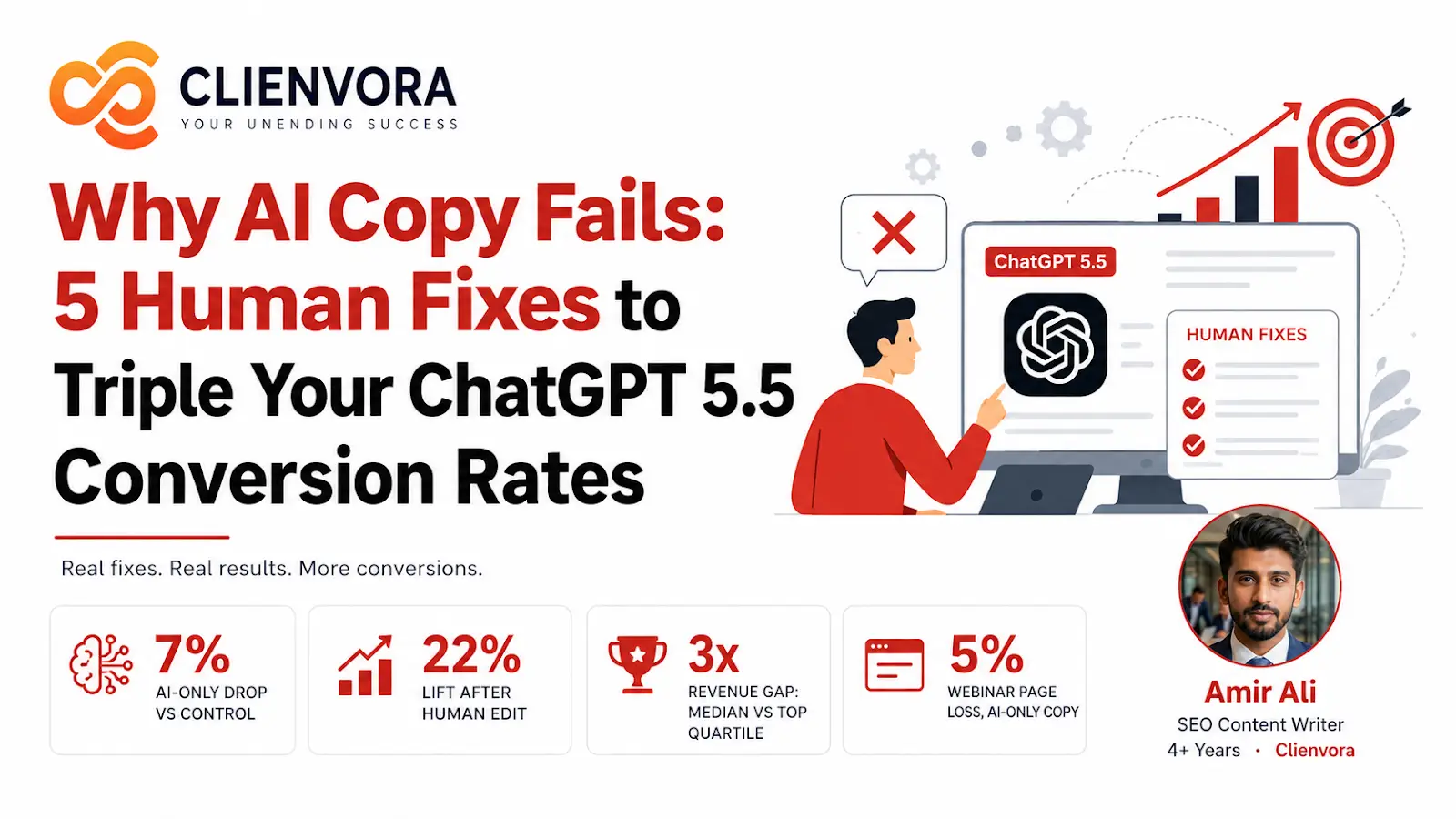
AI can generate structurally sound product descriptions at scale. It cannot independently perform the VoC extraction, objection identification, and emotional bridging that produce the conversion lift. The 26 percent gap between AI-only and human-refined product copy comes from the calibration phase: stakes injection, review-based objection handling, and risk reversal placement. Use AI for the construction phase at scale. Assign the calibration phase to a human. See why AI copy fails for the specific calibration tasks.
Final Thoughts
Ecommerce copywriting services improve the conversion rate on traffic you already paid for. The difference between a 1.4 percent product page and a 2.7 percent product page is not traffic quality or product quality. It is whether the copy speaks the customer's own language or the manufacturer's language. Mine the reviews. Rewrite the architecture. Watch the revenue compound.
Get a free product page copy audit from Clienvora. We'll analyze your highest-traffic product page and deliver a prioritized rewrite plan. For the landing pages that feed it, see landing page copy that converts.